Private analytics systemPublic case study

Molly Intelligence

A private sportsbook analytics workbench I built to turn player activity, pricing, exposure and profitability signals into clearer commercial decisions.

Public-safe by design

Every entity, threshold, financial value and outcome shown on this page is synthetic. The live system and its underlying data remain private.

Context
Independent advisory work since 2023
My contribution
Analysis, product design and AI-assisted build
Decision focus
Campaigns, player value, pricing and risk
Access
Private system · synthetic public demo

Context

The dashboard is not the point. The decision is.

Sportsbook decisions rarely depend on one clean metric. Player behaviour, profitability, market context, offer mechanics, exposure and uncertainty have to be considered together. I needed a more structured and repeatable way to move from raw evidence to a commercially useful recommendation.

The problem

Too many signals, too little decision structure

A promotion can look attractive on turnover while weakening unit economics. A player can look profitable or unprofitable because of noise. A rule can appear effective in a simple before-and-after comparison while regression to the mean explains the change.
My role

Own the reasoning from question to review

I designed and iterated Molly primarily for my own analysis within an independent sportsbook advisory engagement. I own the problem framing, analytical logic, validation and AI-assisted build workflow, then use the output to prepare clearer recommendations and measurement plans.

Scope boundary: Molly supports my analysis. It is not presented here as a client-commissioned product or a client-wide deployment, and I do not claim ownership of campaign execution or the client's campaign tools.

Decision workflow

From a commercial question to a reviewable recommendation

The workflow keeps the analytical steps visible so a recommendation can be challenged, refined and evaluated after the decision.

  1. 01

    Frame the decision

    Start with the commercial question: an incentive, a pricing test, a player-value decision or a post-launch review.

  2. 02

    Combine the signals

    Bring player activity, profitability, pricing context, open exposure and offer mechanics into the same view.

  3. 03

    Quantify uncertainty

    Use calibration, confidence intervals and shrunken estimates so noisy evidence is not mistaken for certainty.

  4. 04

    Support a human decision

    Prioritise the cases worth reviewing, make trade-offs explicit and keep thresholds subject to expert judgement.

  5. 05

    Define the review

    Decide what will be measured after launch or intervention before the result is known.

Representative case

Evaluating an incentive before it becomes an expensive assumption

One advisory contribution illustrates the kind of commercial reasoning Molly is designed to support. No real campaign figures or results are disclosed.

01

Question

Would a planned volume-based rewards campaign create incremental value under the proposed mechanics?

02

Analysis

I reviewed historical activity and profitability data alongside the proposed pro-rata and tiered reward structure.

03

Recommendation

The proposed mechanics had negative expected value for the operator, so I recommended changes to the structure and wagering requirements before launch.

04

Measurement plan

Define participation, turnover, unit margin, net contribution and customer-value checks before evaluating the campaign.

Planning and analytical contribution only · no claim of end-to-end campaign execution

Advanced analytical views

Designed around action, uncertainty and review

These public-safe visuals recreate representative analytical workflows with synthetic data. They demonstrate the reasoning and interface patterns without exposing customers, commercial thresholds or live performance.

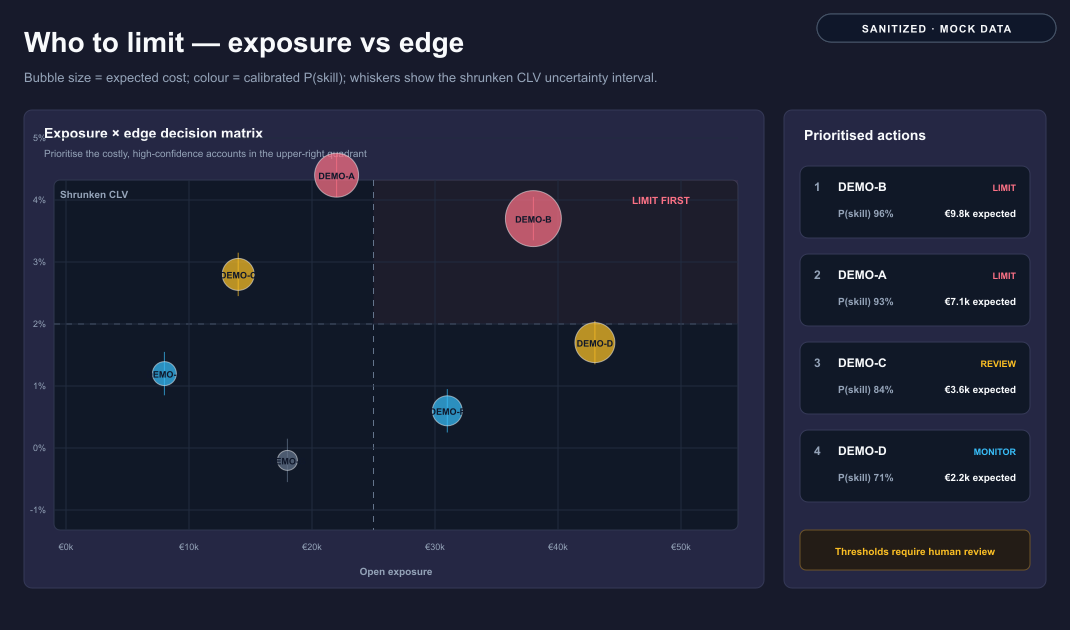
01 · Decision prioritisation

Prioritising exposure with uncertainty

A representative prioritisation layer combining shrunken closing-line value, exposure, posterior skill probability, expected cost and uncertainty. The purpose is not to automate a restriction: it is to surface the cases that merit expert review first.

Synthetic decision matrix plotting open exposure against shrunken closing-line value with prioritised human-review actions
Synthetic demonstration dataNo customers · no live thresholds · no commercial results

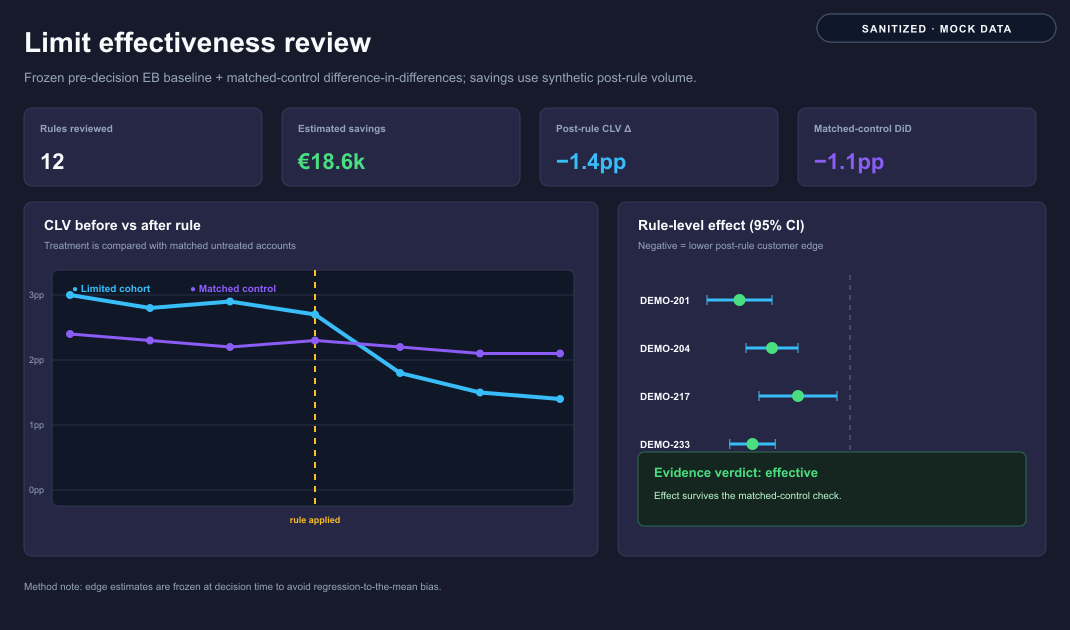
02 · Outcome review

Evaluating an intervention after the decision

A synthetic post-decision workflow using a frozen pre-decision baseline, matched controls, difference-in-differences and rule-level confidence intervals. This makes the evaluation logic visible instead of relying on a simple before-and-after comparison.

Synthetic limit-effectiveness dashboard with matched-control difference-in-differences and confidence intervals
Synthetic demonstration dataNo customers · no live thresholds · no commercial results

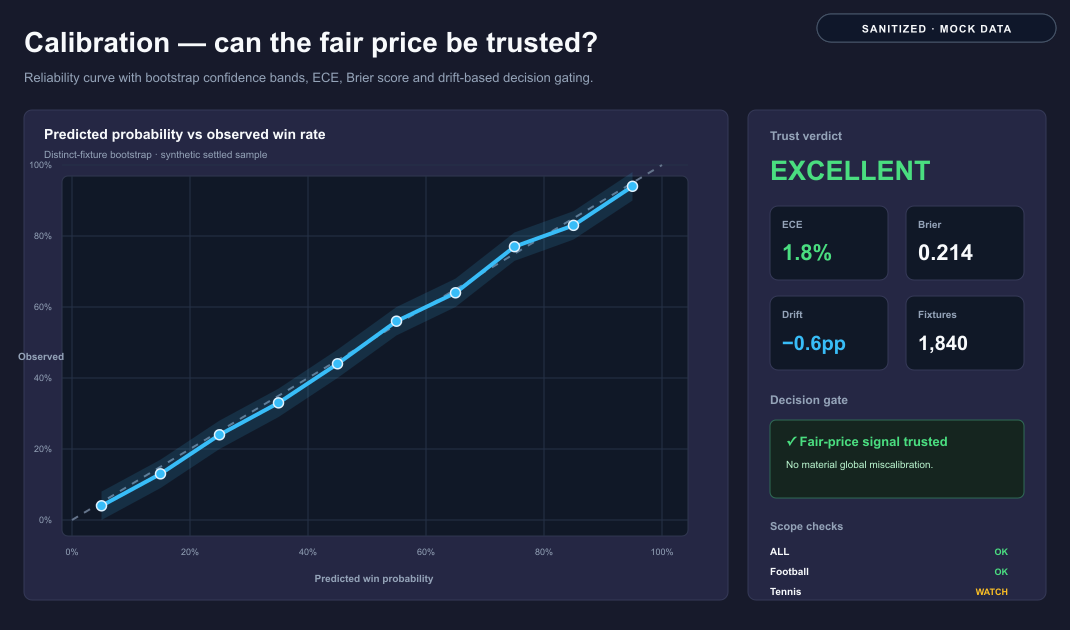
03 · Model trust

Testing whether a price signal can be trusted

A reliability view for comparing predicted probabilities with observed outcomes. Calibration error, Brier score, drift and scope-level gates help separate a useful decision signal from a model that needs more evidence.

Synthetic calibration dashboard comparing predicted win probabilities with observed outcomes
Synthetic demonstration dataNo customers · no live thresholds · no commercial results

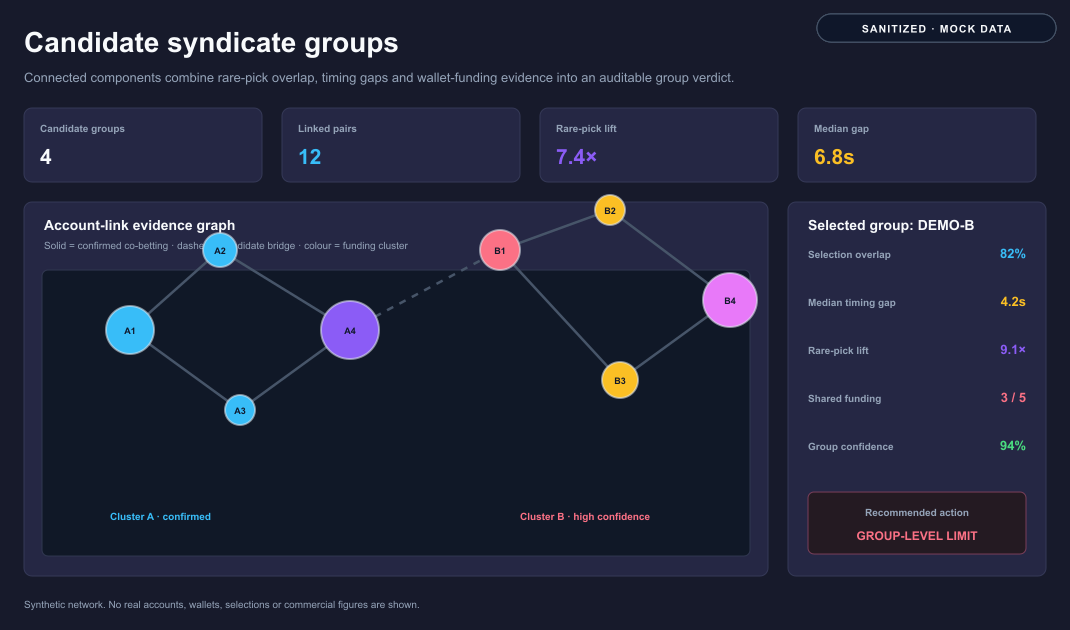
04 · Integrity analysis

Tracing network evidence without hiding the reasoning

A synthetic network view combining repeated co-activity, rare-selection lift, timing gaps and shared-funding evidence. Group-level recommendations remain traceable to the underlying signals and subject to human review.

Synthetic network analysis showing candidate linked account groups and supporting evidence
Synthetic demonstration dataNo customers · no live thresholds · no commercial results

What the work demonstrates

A sportsbook domain problem translated into a usable analytical product

The value is in connecting quantitative evidence to a real decision, not in producing another collection of charts.

  • Campaign and offer analysis
  • Player activity and profitability exploration
  • Customer-value and retention decision support
  • Pricing and market-context review
  • Exposure and expected-value framing
  • Calibration and uncertainty controls
  • Post-decision measurement planning
  • Auditable integrity investigation

Implementation

Domain logic first, AI-assisted delivery second

I use AI tools to accelerate implementation, while retaining ownership of the commercial question, analytical logic, validation and the final output.

Interface
Next.js, TypeScript, ECharts
Analytics
Python, FastAPI, pandas, scipy
Data
PostgreSQL and reproducible analytical workflows
Build method
AI-assisted delivery with Claude Code and OpenAI Codex

Confidentiality is part of the product design

The production system stays behind authentication. This public page contains no source data, client identity, account information, credentials, live thresholds or proprietary implementation detail. The visuals preserve the analytical structure while replacing every entity and value with synthetic demonstration data.

Outcome and learning

Make the reasoning visible before asking the business to act.

Molly gave me a more consistent way to structure analysis, compare hypotheses and prepare evidence-based recommendations. Its most important design principle is simple: every view should connect to what could change, why it could change and how the result will be reviewed.

Commercial outcomes remain confidential and are not claimed on this page. A guided walkthrough using synthetic data is available for interviews and relevant professional discussions.